
More often than not, most founders start discovering Investor Partners the moment a competition round opens.
But by then, it's usually too late. The companies that will win have already done the hard part; they've secured an Expression of Interest from an Investor Partner months ago.
So while you're still understanding how the process works, they are already finishing their application.
And honestly, getting an approved investor partner to back you takes time you cannot buy back once the clock is running.
I co-founded a company that won an Investor Partnership round, and I'm also a former Innovate UK EDGE advisor (delivered through Newable). I've also successfully secured 25+ grants for founders and clients.
So this is the guide I wish someone had handed me on how the Innovate UK Investor Partnerships process actually works, and where to put your effort to win.
TLDR;
- What it is: an Innovate UK grant for your research and development, paired with equity investment from an approved investor partner.
- Who it is for: UK micro, small and medium businesses doing genuine R&D that also want to raise equity.
- The process: Target the right investors, secure the Expression of Interest (EOI), submit the grant application.
- The catch: you cannot get the grant without the investment, and the investor has to come from Innovate UK's approved list.
Should you apply for Innovate UK Investor Partnerships?
Investor Partnerships is not for everyone, and that is the point. It funds two things at once: a grant for your research and development and an equity investment from an approved investor partner.
It suits you if:
- You are a UK micro, small or medium business doing genuine R&D.
- You actually want equity investment, not just grant money.
- You are a credible bet for an investor: a strong team, a serious opportunity, and ideally some early traction.
Skip it if:
- Your project adopts or integrates technology that already exists. An AI feature in your product is not an R&D project, and assessors know the difference.
- You do not want investors on your cap table. The grant does not come without the aligned investment.
- You sit outside the sectors in scope.
On that last point, there is a sector gate.
Since spring 2025 the programme tracks the UK Industrial Strategy, and the sectors currently in scope are:
- Advanced manufacturing
- Clean energy industries
- Creative industries
- Defence and security technologies
- Digital and technologies
- Life science
Do not stop at the sector heading, though, because each one breaks down into sub-sectors.
Digital and technologies, for example, spans six frontier technologies: artificial intelligence, quantum, cyber security, semiconductors, advanced connectivity and engineering biology.
That distinction decides whether you are eligible.
Say you are building quantum sensing hardware. You check the sector list, see digital and technologies, and start writing.
But if the live round is scoped to artificial intelligence, you are out of scope before you begin, and you will be rejected before a single answer is scored.
So "my sector is on the list" is not the same as "I am in scope." Find your sub-sector named in the live competition brief before you commit any time to this.
Scope can shift a little from round to round, so check the live competition brief, and read how the model works on Innovate UK's site.
The funding deal in plain terms
You get a grant for part of your project costs, and you bring matched equity investment alongside it.
The grant covers:
- Up to 70% of costs for a micro or small business, or 60% for a medium-sized one, on feasibility studies and industrial research.
- Up to 45% and 35% on experimental development, which sits nearer to market.
The aligned investment you bring must be:
- At least the same as the grant for feasibility and industrial research R&D projects.
- At least twice the grant for experimental development R&D projects.
The exact pot changes each round, so check the live listing for the current figure.
Is it worth the effort? For the right companies, 100% yes.
Innovate UK reports that since 2017 the programme has put £168 million into 417 SMEs, those companies have secured £448 million of aligned investment from 105 investor partners, and they have raised £1.36 billion in follow-on funding on top.
This is a real route to capital, not a side scheme!
How the process actually works
Forget the grant for a second. The whole thing turns on one fact that catches most founders out: you do not submit the expression of interest. An approved investor partner does, on your behalf.
So this is less "fill in a form" and more "win an investor, then apply together."
Here is the full path, start to finish, in six simple steps:
- Get investment-ready.Make sure you are genuinely ready to take external investment. Using the suitability checker on Growth Catalyst can be really helpful. It takes only a few minutes to complete and will help you understand quickly if your application is likely to be suitable
- Shortlist approved partners.Use the official directory (linked below) to find approved partners whose focus matches your sector, stage and cheque size.
- Build the relationship.Get in front of your shortlist early and make them want to back you.
- The investor submits an expression of interest (EOI).This is the first formal step, and only they can take it.
- You write & submit the grant application.It is scored independently against the competition criteria.
- You confirm the aligned investment.Led by your partner, it has to be in place to start the project.
Steps two to four are where this competition is usually won or lost.
But to look at the bigger picture, you can think of the process in three big steps:
Step 1: Target the right investors
Innovate UK keeps a public directory of approved investor partners. It runs to venture funds, corporate investors, angel groups and social impact investors, each with a different focus on sector, stage and cheque size. Browse the official Investor Partner directory and read the public summary each partner publishes.
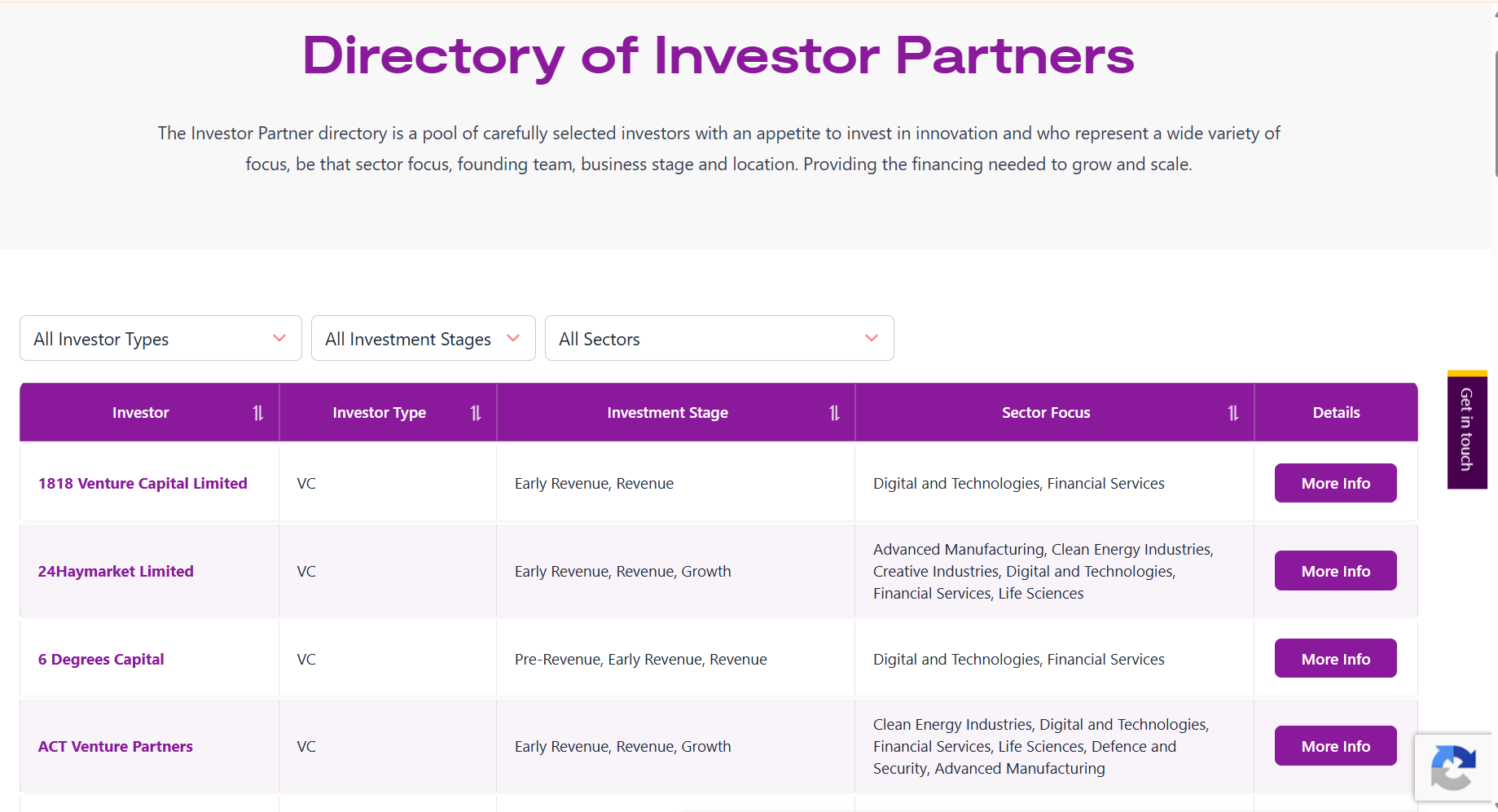
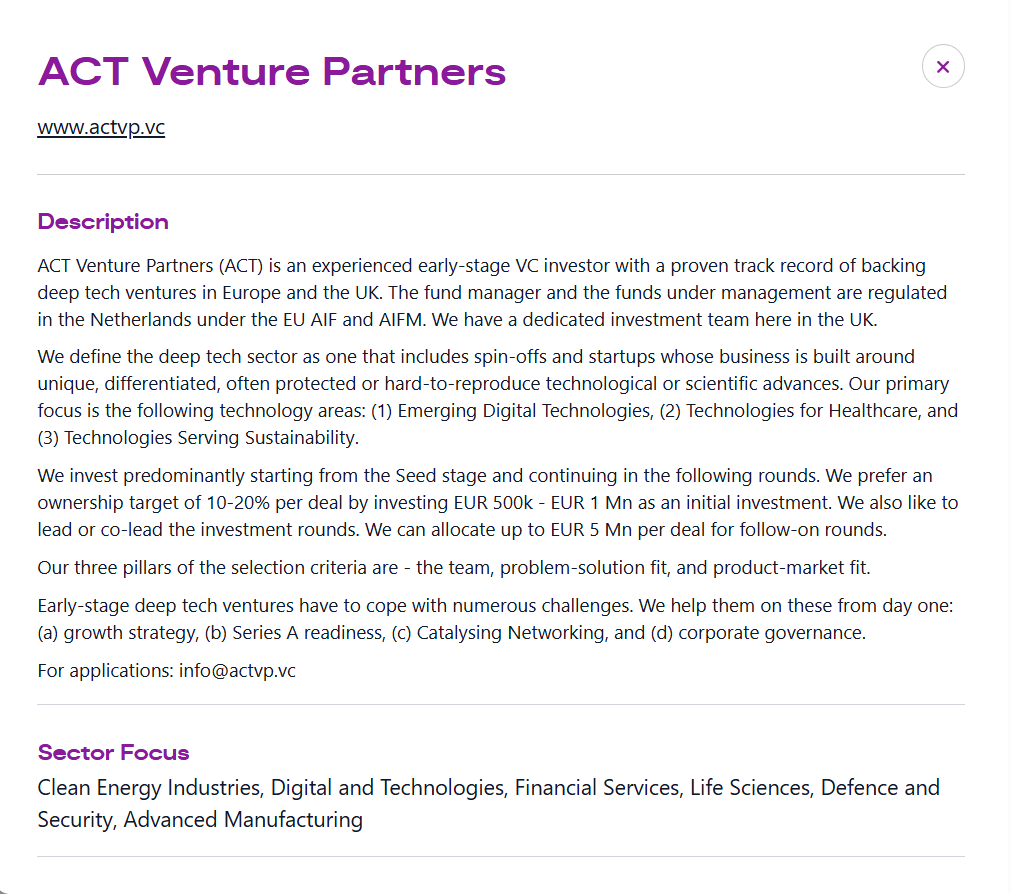
Each public summary tells you three things you need:
- What they invest in, by sector and stage.
- How much they typically write in a single cheque.
- How they want to be approached.
Use the 'investor types', 'investment stages' and 'sector' filters properly.
The right partner is one whose stated focus matches your sector, backs companies at your stage, and writes cheques the size you need.
A deep-tech seed fund is no use to you if you are raising a Series A in creative industries, however impressive they look.
A clean fit with three partners beats a generic pitch to thirty. And remember the one rule that governs all of this: the decision to co-invest is theirs, not yours to demand. They see thousands of pitches and back a handful.
Step 2: Secure the expression of interest
Once a partner is interested, they submit the expression of interest. It describes your proposed R&D project and sets out their possible interest in investing. That is the first formal step in the grant application, and you cannot take it without them.
So your job before any deadline is to make an investor want to put their name to you. Treat it like a fundraise, because that is what it is, with a grant attached as the sweetener.
Get a short, sharp summary in front of them that covers:
- The problem you solve, and why it matters now.
- Why your technology is genuinely new, not an existing tool repackaged.
- The size of the prize if it works.
- Who is on your team, and why they can deliver it.
- The proof you are already moving: pilots, letters of intent, early revenue, a waiting list.
Do this early. Once a round opens, partners are fielding a lot of interest at once and their bandwidth drops fast.
The founders who win are the ones an investor already knew and liked weeks before the form went live.
Step 3: Work on and submit the grant application
With a partner behind you, the grant becomes a standard Innovate UK scored application, marked independently against the competition's criteria.
Here are the things that bite hardest:
- Match your risk to your innovation. It is tempting to make the project sound safe and certain. Do not. Assessors mark down a low-risk framing, because if there were no real risk, you would not need public funding. Be honest about the technical risk, then show how you will manage it.
- Write for smart assessors but note that they're not always from your niche. Your assessor knows your field but is not a specialist in your exact corner of it. They only score what is on the page, and they give no benefit of the doubt. So spell out every link in your logic, explain your acronyms, and never assume they will infer the obvious.
- Provide solid evidence. A number with a credible source beats a paragraph of enthusiasm every time. If your CTO has shipped a comparable system before, say so plainly. Address every bullet a question asks, because an unanswered part scores zero, not a generous guess.
Underpinning all of this is scope. If your project is out of scope, it is rejected before it is scored, however strong the rest is, so map your project onto the exact words of the brief.
This is also where most founders realise the application is a discipline of its own, separate from the science and separate from the investor work. It is the part I know best. I have secured over £8m in non-dilutive grant funding for clients and 25+ grants for founders, and I still write these applications live rather than commenting on them from the outside.
So here is the honest way to think about getting help. Grant funding is competitive and probabilistic. You win by making attempts that are genuinely fundable.
The real question is how do you get quality and speed at the same time?
Generic AI will not get you there. It writes fluently and fast, but what it gives back is capped by what you know to ask for, and a founder who does not know what assessors score against cannot ask for it. You end up with something polished that quietly misses the criteria, and a wasted submission.
ChatGPT answers your questions. The harder job is asking you the right ones.
That is what I built GrantHero to do. It runs the structured questioning an experienced consultant runs, drawing out the evidence and the commercial logic that actually get scored, before anything is drafted.
It then drafts from what your business already has, appendices and finance case included, and a human expert reviews the result against how assessors really mark, so you find out where you dropped marks while you can still fix them.
So you get the thinking of a good consultant, built on real assessor-side insight, at a fraction of the time and cost.
One last thing to hold onto: an expression of interest is not the finish line.
To actually start the project, you need the aligned investment confirmed and led by your approved partner, not just their early interest.
What actually helps you win
Here is the part almost no one spells out, and it is the whole reason this competition is different from a normal grant.
Most Innovate UK grants come down to one important question: how well does your application score on innovation?
Investor Partnerships is decided on three things, and you have to be strong on all of them.
| Factor | Who decides it | Where the evidence comes from |
|---|---|---|
| Innovation | Independent assessors | Your written application |
| Additionality | The Investor Partnerships team | Your named investor partner, before the decision |
| Traction | The Investor Partnerships team | Your named investor partner, before the decision |
Look at the last column. Two of the three are not judged on what you write. They are judged on what your investor partner reports about you, to a different team, before the funding decision is made.
You cannot write your way to a good score on them the week before the deadline.
That is exactly why the founders who win start months earlier.
And here is what those two actually mean, because they do not mean what you might expect.
Additionality: How much extra investment the grant brings in
Put the textbook definition aside. In this competition, additionality is about the effect the grant has on your round: how much more investment it pulls in, and how much sooner.
An example makes it clear. Say you have £200,000 committed from an approved investor, and you apply for a £200,000 grant. That meets the one-to-one match the rules ask for.
Now say the grant gives a second investor the confidence to join the round with another £100,000. That extra £100,000 is your additionality.
So do not just hit the minimum match and stop. The more investment your grant brings into the round, the better you score here. Build the round so the grant is the thing that gets other investors off the fence.
Traction: Proof the investment is really going to happen
Traction here is not your headline pitch-deck traction. It is what you have done since you applied for the grant.
Innovate UK is weighing one thing: how likely is this investment to actually complete, and soon? They normally expect it to close within three months of the funders' panel.
The evidence is your momentum, reported by your investor partner. Fresh revenue, new signups, a partnership signed, a pilot moved on a step, all of it says the same thing. This company is moving, so the deal will close.
So the months between applying and the decision are not dead time. Keep selling, keep shipping, and keep your investor partner in the loop, because they are the ones telling Innovate UK how you are doing.
FAQs:
How does the aligned investment actually work?
You take two kinds of money together. The grant from Innovate UK is non-dilutive, so you do not give up equity for it. The aligned investment from your partner is equity, so you do. The investment has to be at least the same size as the grant for feasibility and industrial research projects, and at least twice the size for experimental development. It can come from a single investor or a syndicate, but it must be led by an approved partner.
Do I still get the grant if I cannot secure the investment?
No. The aligned investment, led by an approved partner, is a condition of the funding. The expression of interest gets you into the process, but you need the investment confirmed to start the project.
Can any investor back me?
Only investors on Innovate UK's approved list can lead the aligned investment, so start from the directory rather than your existing contacts. If a favourite angel of yours is not on the list, they cannot be the lead.
How long does this take?
Longer than you think, because the slow part is the investor relationship, not the form. Treat it like a fundraise that runs months ahead of any deadline. Check the live competition listing for current round timings.
Before you do anything else
If you take one thing from this, take this: start the investor conversation now, not when a round opens. The grant rewards a good application. Investor Partnerships rewards a company that did the relationship work months in advance.
Three moves to make this week:
- Pick your three best-fit partners from the directory.
- Get yourself genuinely investment-ready.
- Open those conversations, warmly and early.
The application follows more easily once an investor is already in your corner.
And if you want to know the moment a competition that fits your business opens, sign up to our free Discovery tool and we will match you proactively, so you are never the founder who finds out too late.
Sign up to our free Discovery tool